
Long before genomics became a buzzword in Africa, scientists at the Kwame Nkrumah University of Science and Technology, Kumasi (KNUST) were making discoveries that would reshape the understanding of hereditary deafness.
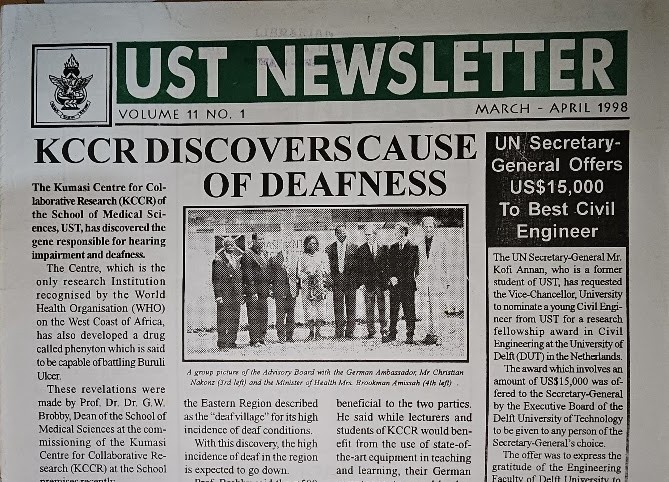
In 1998, the then University of Science and Technology (UST) announced what was described at the time as the discovery of the cause of hereditary deafness in Ghana. Splashed across the front page of the UST Newsletter under the headline "KCCR Discovers Cause of Deafness", the breakthrough marked one of the University's earliest internationally recognised biomedical research achievements.
Today, nearly three decades later, the discovery remains a defining milestone in the history of the Kumasi Centre for Collaborative Research (KCCR), now one of Africa's leading biomedical research institutions.
A village that changed medical science
The breakthrough emerged from years of painstaking research in Adamorobe, a community in Ghana's Eastern Region known internationally for its unusually high prevalence of hereditary hearing impairment.
Led by Professor George W. Brobby, then Dean of the School of Medical Sciences, researchers at KCCR investigated families in the community in collaboration with scientists from Germany's Bernhard Nocht Institute for Tropical Medicine.
Their work culminated in the identification of a mutation in the Connexin 26 (GJB2) gene responsible for an inherited form of non-syndromic hearing loss among affected families.
The findings were published in The New England Journal of Medicine in February 1998, placing Ghanaian biomedical research on one of the world's most prestigious scientific platforms.
While the UST Newsletter described the finding as the "cause of deafness", subsequent advances in genetics have shown that hearing loss has many different causes. The 1998 discovery specifically identified one of the major genetic causes of hereditary deafness in the Adamorobe population.
More than a scientific breakthrough
The discovery represented more than an academic achievement.
It demonstrated that African scientists, working with international collaborators, could produce world-class research capable of influencing global scientific understanding.
At a time when genomic research was largely concentrated in Europe and North America, KCCR's work provided one of the earliest genetic studies from Africa to gain widespread international recognition.
The research also highlighted the importance of studying diseases and inherited conditions within African populations rather than relying solely on findings from elsewhere.
The legacy continues
Today, KCCR's research portfolio extends far beyond genetics.
Its scientists lead internationally recognised studies in malaria, neglected tropical diseases, tuberculosis, emerging infectious diseases, antimicrobial resistance, cancer, public health genomics and vaccine research.
The Centre played a prominent role during the COVID-19 pandemic by providing nationwide laboratory testing and has continued to contribute to regional and global disease surveillance efforts.
Its researchers collaborate with institutions across Europe, North America and Africa while training the next generation of scientists through postgraduate education and international partnerships.
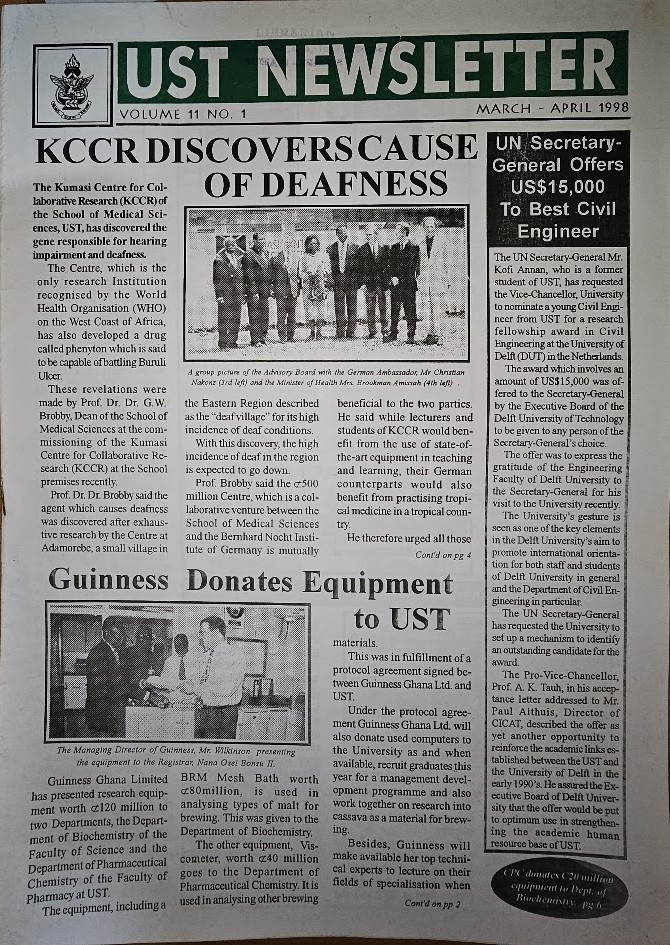
Story: Emmanuel Kwasi Debrah Photo/Archive Credit: UST Newsletter, Vol. 11, No. 1 (March–April 1998), Prempeh II Library Archives, KNUST.


